
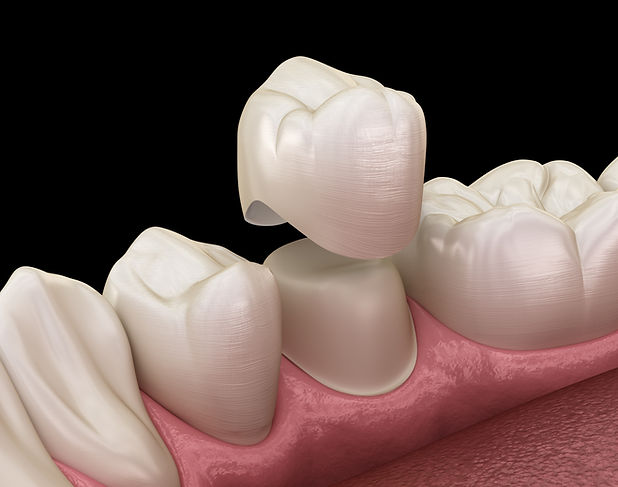
A crown covers a tooth completely, protecting what remains of it and restoring its shape, strength and appearance. It is used when a tooth has been weakened past the point where a filling would hold or protect it reliably — after a fracture, a large restoration, root canal treatment, or significant wear.
The crowns provided here are all-ceramic, designed digitally and produced using CAD/CAM. The tooth is recorded with an intraoral scanner rather than impression material, so there is no tray, no putty and nothing setting in your mouth.
Crowns - Tel Aviv Dentist - Dr. Meytal Salman
A crown either fits at the margin or it does not, and that margin is where everything is decided. A digital scan removes several of the places where accuracy is traditionally lost: there is no impression material to distort as it sets, no tray to shift while it does, and no plaster model in between. The scan is reviewed on screen at magnification while you are still in the chair, so an unclear margin is rescanned in seconds rather than discovered at the laboratory a week later.
All-ceramic crowns transmit light in a way that resembles natural enamel. With no metal substructure, there is no dark line at the gum margin as the gum recedes over the years — which is what most often makes an older crown begin to look like a crown.
The tooth is assessed along with the bite and the surrounding gum, prepared under local anaesthetic, and scanned. The crown is designed on that scan and produced from an all-ceramic block, with a temporary fitted in the meantime. At the final visit it is checked for fit, bite and shade, adjusted where needed, and bonded in place.
To discuss options for your crown restoration please call 03-551-2510 to book a consultation.